AI Policy in FemTech: Part 1

AI Policy in FemTech
It is very likely that you or many people you know use FemTech, which is rapidly integrating artificial intelligence (AI). This blog series explores why FemTech requires unique strategies and considerations in federal- and state-level AI policies.
Part 1 gets into what FemTech is, how it differs from general health tech, and why the problems it faces with AI are distinct. Part 2 will offer concrete examples of AI legislation affecting FemTech, along with suggested policy levers.
Women's Health and FemTech Represent Distinct Areas of Focus.
Women's health is human health. Women's health extends far beyond reproduction, shaping workplaces, budgets, medical training, research funding, and policy. Yet for most of the history of medicine, women were systematically excluded from research and clinical trials. The “standard” user in medical research and health tech design was, by default, a 150-pound male. Women's health was dismissed as “bikini medicine,” meaning only the parts of the body covered by a bikini were considered important. This has led us to where we are now, in the age of rapid AI innovations, with a significant lack of women's health data.
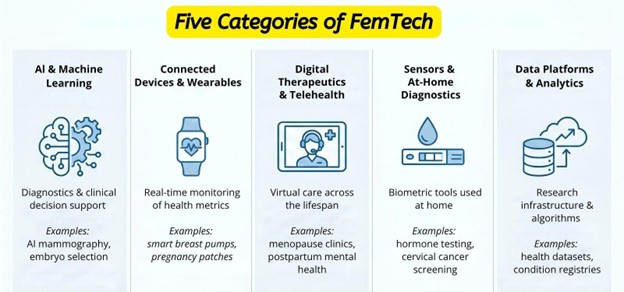
FemTech (coined in 2016 by Ida Tin, founder of Clue) emerged in part to address these gaps in women's health and is generally defined as technology-driven products and services that aim to improve health outcomes for people with female biology. The first decade of FemTech delivered significant advances in women's health for things like menopause platforms, at-home diagnostic tools, fertility tracking, telehealth access, and community support for a wide range of conditions. Now, a fundamental shift, called deep FemTech, is emerging and leading to even more significant science-driven innovations targeting underlying biology, such as wearables that detect endometriosis noninvasively and diagnostics that predict preeclampsia early.
Does “MaleTech” Exist?
The short answer is yes, but it's just called health tech, which was built with male biology as the default. One reason FemTech exists is that the default has left significant gaps in care and innovation for people without male biology. Women's health is often seen as a proxy for a healthcare system that benefits everyone and has a history of advocacy that carries through to today's FemTech, which serves cisgender women, transgender men, nonbinary people, and other historically excluded groups.
AI is Booming in FemTech.
In 2024, FemTech was a $39 billion global market and is projected to grow 17% annually, reaching $97 billion by 2030. FemTech is also rapidly integrating AI to analyze vast amounts of complex health data, provide tailored guidance across life stages, and improve early detection through medical imaging analysis, such as mammograms. New Food and Drug Administration (FDA) frameworks, such as the Predetermined Change Control Plan, which enables continuous AI learning without repeated FDA submissions, have made integrating AI into FemTech easier than ever.
AI Policy and FemTech Collide in Ways That Neither General AI Policy Nor General Health Tech Policy Fully Addresses.
FemTech sits at the intersection of three regulatory blind spots: women are underrepresented in the data on which most AI tools are trained, health data within FemTech largely falls outside the protections of the Health Insurance Portability and Accountability Act (HIPAA), and AI innovations are moving faster than oversight frameworks.
Accuracy of AI Models Depends on the Quality and Representativeness of Training Data
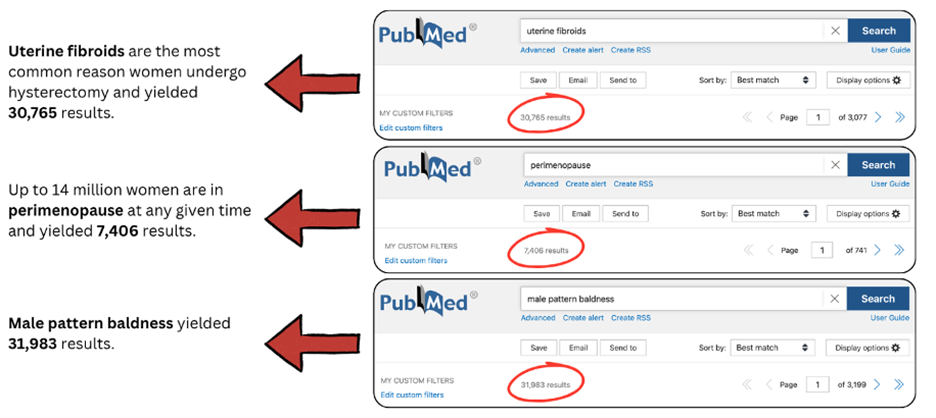
The lack of data, diagnostic challenges, and treatment gaps, particularly for women of color and those outside the reproductive years, is evident in how AI performs in both general health tech and FemTech. A quick PubMed search for uterine fibroids (the most common reason women undergo hysterectomy) yields 30,765 results. Perimenopause (the 5-7-year transition to menopause that 14 million women in the US are navigating at any given time) yields only 7,406. For comparison, male pattern baldness yields 31,983. This means that as of May 2026, PubMed has 4x more results for male pattern baldness than for perimenopause.
The quality and representativeness of training data affect how words are encoded in machine learning. So, an AI model or system trained primarily on male data or on data from women aged 25 to 35 will perform poorly for a 52-year-old navigating perimenopause. The same is true for an ECG patch that may not account for interference from breast tissue, or a wearable sensor that may not be calibrated for hormonal fluctuations in heart rate variability. We have already seen real-life consequences for women's health. For example, women experience up to 75% more adverse drug reactions than men, partly because drug dosing was tested almost exclusively on men. AI systems also consistently depict secretaries and nurses as women and managers, doctors, and professors as men. Some studies have shown that 45% of AI systems tested showed gender bias, and 25% showed both gender and racial bias. AI trained on similarly skewed data risks repeating that mistake at scale.
Most FemTech Lives Outside HIPAA, Which Is Also an AI Training Data Problem
HIPAA was created to provide privacy protections for health data. Almost 90% of FemTech products fall outside these protections because they aren't classified as “covered entities” like hospitals, insurers, or traditional healthcare providers. This has allowed data on menstrual cycles, reproductive status, and pregnancy to be shared with third parties, used in advertising platforms, or accessed through legal processes without violating healthcare privacy laws.
For example, in 2020, Glow, a menstruation and fertility app, shared sensitive data without consent. The $250,000 settlement included a first-of-its-kind injunctive term requiring Glow to consider how privacy and security lapses may uniquely impact women, which was written into the settlement. The Federal Trade Commission (FTC) has taken similar actions against Flo and Easy Healthcare (Premom). But in most of these situations, the data had already been collected, already used to train models, and already ended up in the hands of partners and data brokers. Fines come after harm, and the FemTech AI training pipeline persists without any tangible reform.
A Health and Human Services (HHS) rule in 2024 sought to help with this regulatory gap by protecting reproductive health data, but a federal court vacated most of it in June 2025. Three federal bills track reproductive data privacy: the My Body My Data Act, the Protecting Personal Health Data Act (S. 24), and the Reproductive Data Privacy and Protection Act. However, none have been enacted. This lack of FemTech data protection has become more consequential since Dobbs v. Jackson in 2022, because in states with abortion restrictions, reproductive health data carries real legal risk. At least 412 people faced pregnancy-related criminal charges in the first two years after Dobbs, across 16 states.
Next, in Part 2 of this blog series, I will offer concrete examples of AI legislation affecting FemTech, along with suggested policy levers.
Editors
Evelyn Kimbrough, Ph.D.
Sci on the Fly, Editor
2024-2026 Executive Branch Fellow at the National Institutes of Health
Mahlet Garedew, Ph.D.
Sci on the Fly, Editor
2025-2026 Executive Branch Fellow at the Department of Energy
Disclaimer
This blog does not necessarily reflect the views of AAAS, its Council, Board of Directors, officers, or members. AAAS is not responsible for the accuracy of this material. AAAS has made this material available as a public service, but this does not constitute endorsement by the association.
Authors