
Why is there an S&T Policy Fellow in the Judicial Branch?

This entry is part of a series on the role of science in the federal judiciary.
This year, the American Association for the Advancement of Science (AAAS) Science & Technology Policy Fellowships (STPF) placed more than 175 policy fellows across all three branches of the federal government. It is easy to understand why scientists would be placed in executive branch agencies, such as the National Institutes of Health and the National Science Foundation. The need for scientists to help legislators in crafting policy related to science and technology is also clear.
But what can a scientist offer to the judicial branch?
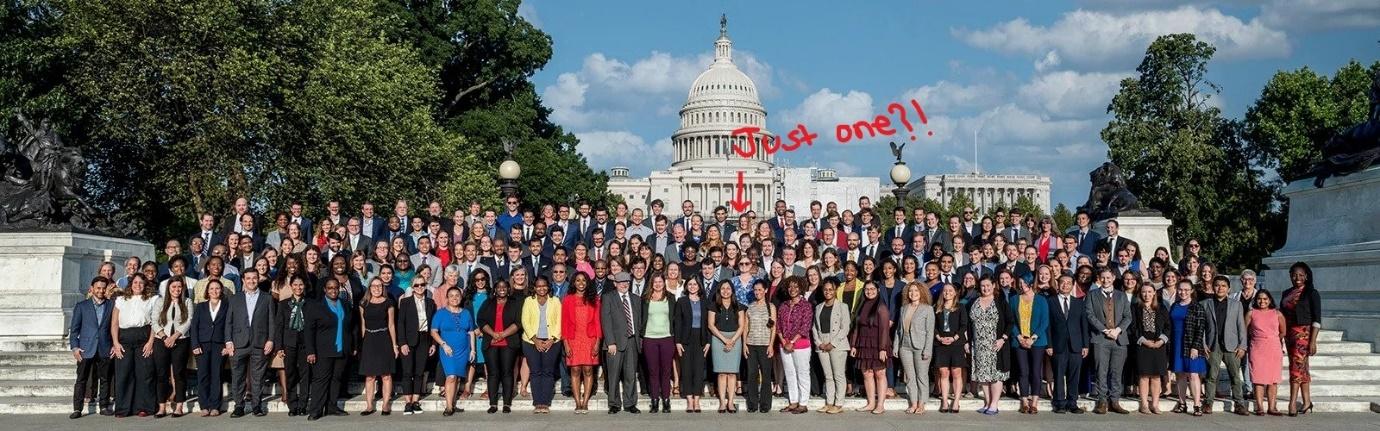
A lone Judicial Fellow stands with the 2023-2024 AAAS STPF class in front of the Capitol building.
Scientific issues are an inescapable part of the work of the courts. Because of that, federal judges must develop a working knowledge of science to perform their role. District judges preside over criminal cases involving DNA and other kinds of forensic evidence. On the civil side, they hear motions in non-criminal cases, such as those based in patent law, product-liability, or other individual and class action “tort” lawsuits, where some harm arises from another party’s acts or omissions. Science’s courtroom role is often stretched far beyond that of the classic TV forensic science.
When a judge presides over these cases, they have to rule on procedural motions, determine who qualifies as an expert witness, and act as the gatekeepers of evidence in the courtroom, deciding which types of scientific evidence get admitted. Typically, juries are the “trier of fact,” deciding if something existed or occurred, but in bench trials judges are the trier of fact. As a result, judges are tasked with acting as either gatekeepers or triers of fact and have to understand scientific processes, methods, and challenges, usually without any advanced training in science.
Over the years, the Federal Judicial Center, the research and education agency of the federal judiciary, has created resources and tools to assist judges in evaluating scientific evidence. Accordingly, STPF Judicial Branch fellows are placed here, often to help inform and update these resources and tools. Over the years, fellows have developed many scientific resources covering topics in neuroscience, genetics, and hydrology. These resources are available on the Federal Judicial Center’s website and are accessible by judges and the public. Fellows have also worked on FJC collaborations with organizations such as the National Academies of Science, Engineering and Medicine and AAAS on projects, such as the upcoming 4th edition of the Reference Manual on Scientific Evidence, a 2,000+ page absolute banger of a book on 17 scientific areas.
This year, the STPF Judicial Branch fellowship is approaching its 10th anniversary! In celebration, STPF will be highlighting the accomplishments of Judicial Branch fellows throughout the year. Other blogs in this series will also delve into the roles of science in the judicial system, serving as a primer for scientists in understanding their role and its importance in the court system.
Images: Fine Photographics on Unsplash; AAAS
Disclaimer
This blog does not necessarily reflect the views of AAAS, its Council, Board of Directors, officers, or members. AAAS is not responsible for the accuracy of this material. AAAS has made this material available as a public service, but this does not constitute endorsement by the association.
